
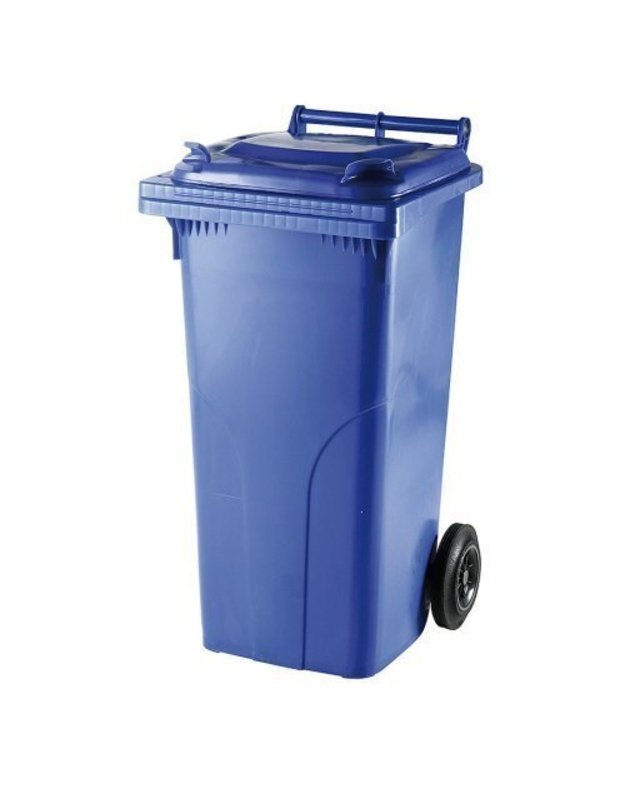
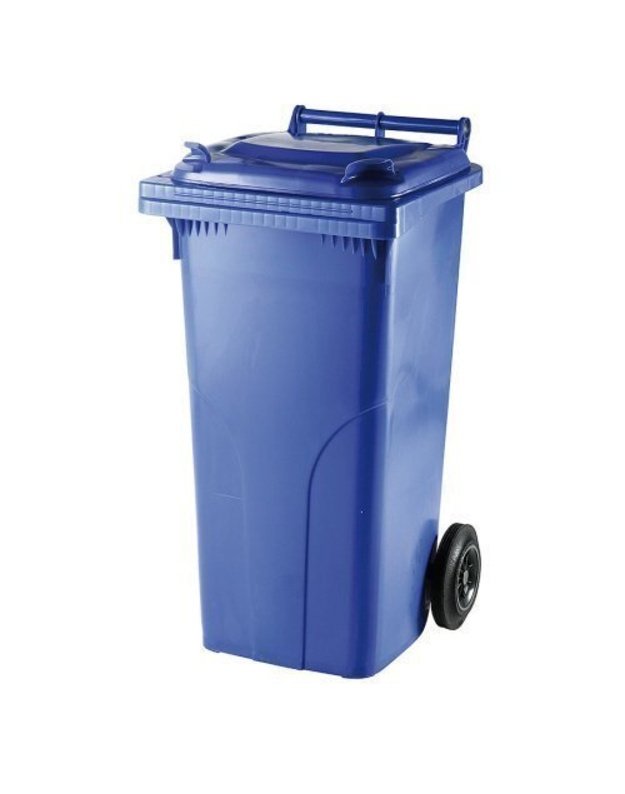

Product code: 120 ltr mėlynas
A blue container for newspapers, exercise books, paper bags and flattened boxes. The lid protects paper from rain so it stays fit for recycling.
Paper and cardboard can be recycled more than once, but only if they do not get wet or dirty from other waste. The blue 120 litre container with lid helps make sure of that: paper is kept separately, enclosed and protected from rain and snow. This size is convenient for homes and small offices that produce a moderate amount of paper.
| Capacity | 120 l |
| Dimensions (width × depth × height) | 485 × 540 × 945 mm |
| Weight | 7.5 kg |
| Permitted load | 48 kg |
| Material | flexible, durable, UV-resistant HDPE plastic |
| Wheels | 2 rubber-tyred, metal axle |
| Included | lid |
| Compatibility | all municipal waste collection vehicles |
| Colour | blue |
Homes that receive a lot of parcels, small offices, libraries, school classrooms and paper collection points of residents' associations. Check with your waste management provider whether blue is really used for paper in your area – local rules may differ.
Take cardboard boxes apart and fold them flat, and put grease-soaked paper in mixed waste – it cannot be recycled. If you produce a lot of paper, consider the blue 240 l container.
| 327_konteineris 120 litru technines charakteristikos.pdf | 511.41 KB | https://viskasmiestui.lt/download/public/327_konteineris 120 litru technines charakteristikos.pdf |
The key factors are how many people use the container and how often it is emptied. Roughly, when waste is collected every 1–2 weeks:
If you are torn between two sizes, it is worth choosing the larger one – the lid of an overfilled container does not close and waste gets scattered.
The most commonly used colour coding is: yellow – plastic, metal and composite packaging, blue – paper and cardboard, green – glass, brown – food and green waste, black – mixed municipal waste, light grey – deposit packaging. A red container is handy for a separate stream, such as textiles or a company's internal recycling.
Requirements may differ slightly between municipalities, so check them with your waste collector before buying.
Yes. The 120, 240, 360, 770 and 1100 l containers we offer have standard dimensions and fixing elements designed for the lifters of municipal refuse collection vehicles. They are serviced by regular waste collectors.
Each container has a specified permitted load – you will find it in the “Technical data” table in the product description. For example, the permitted load of a plastic 240 l container is about 100 kg. Do not put construction waste, soil or stones in the container: they are much heavier than household waste, so the load may be exceeded and the wheels or axle damaged.
A plastic container is light, does not rust, is easy to wash and suits most household and recyclable waste. A galvanised steel container is heavier, but it does not burn and withstands hot ash and sharp or heavy waste, so it is chosen for workshops, manufacturing, boiler houses and places where plastic would wear out quickly.
Yes. We offer 240 l containers with a black body and a blue or green lid, as well as 120 l coloured containers with a body and lid in different colours. This combination is convenient when all the containers in the yard should look the same, with the waste fraction indicated only by the lid colour.
Wash the container with water and ordinary detergent, especially in the warm season – this helps avoid odours and insects. In winter, do not let wet waste freeze to the walls: line the bottom with paper or use bags. Keep the wheel brakes of large containers engaged so the wind does not push the container away.
Containers can be hidden in a dedicated storage enclosure – it protects them from wind, animals and unauthorised people, and the yard looks tidy. We offer storage enclosures for three 120 l, three 240 l and one 1100 l container – you will find them in the “Waste container storage” category.
