
Product code: LANCER-BOLLARD
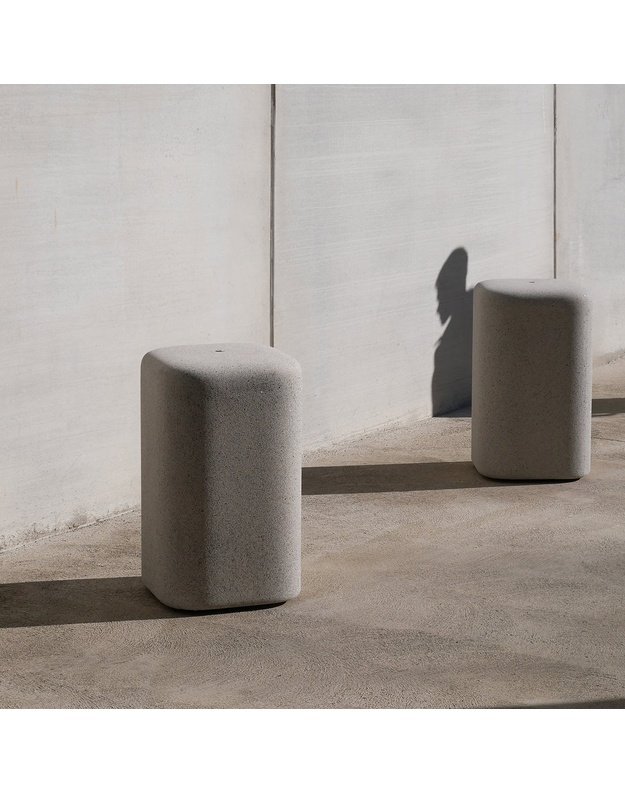
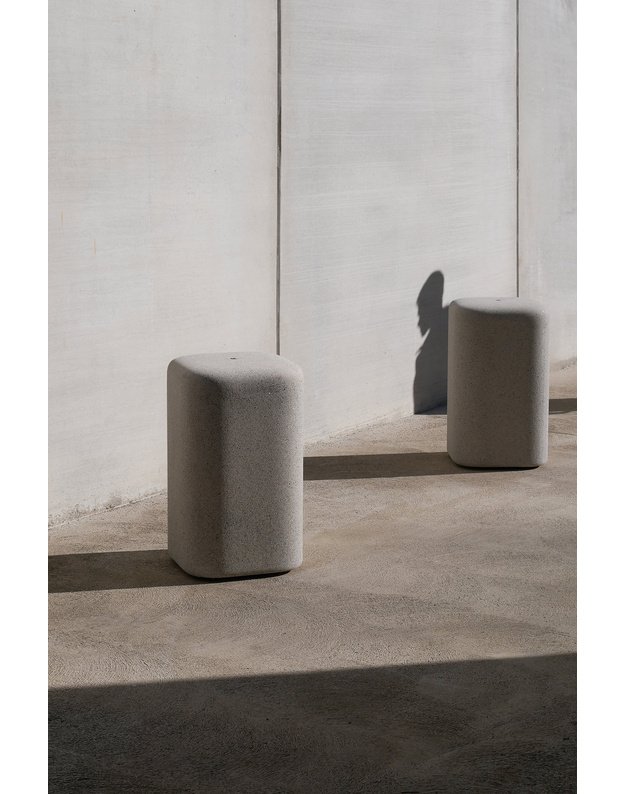
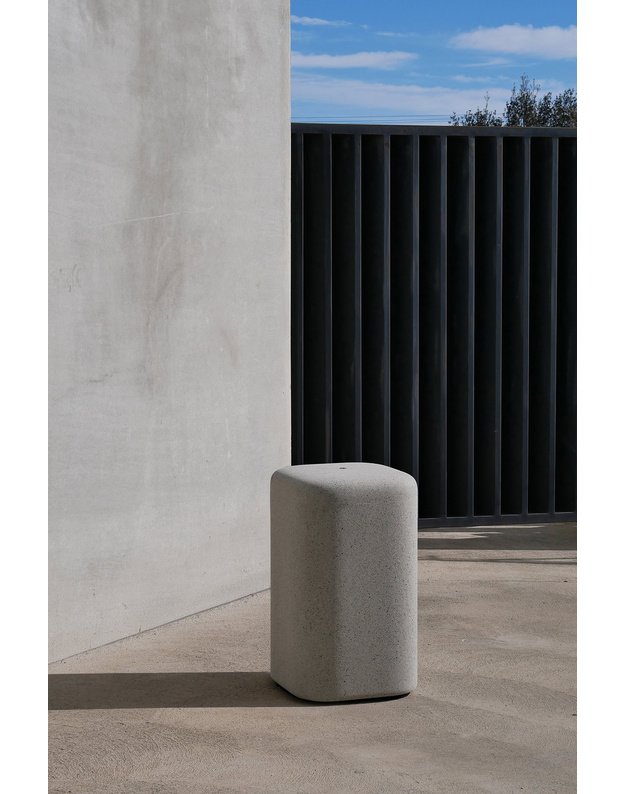
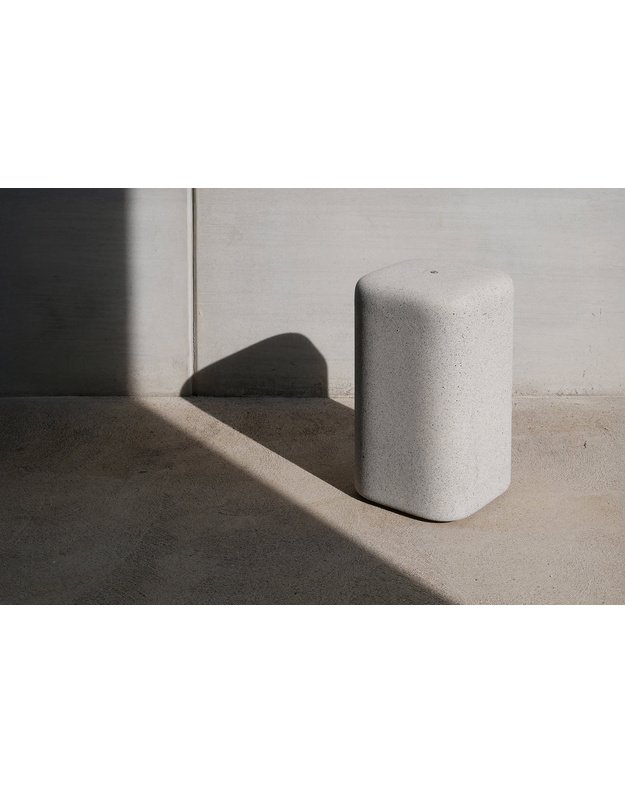
A cast concrete bollard with rounded edges for separating pedestrian zones.
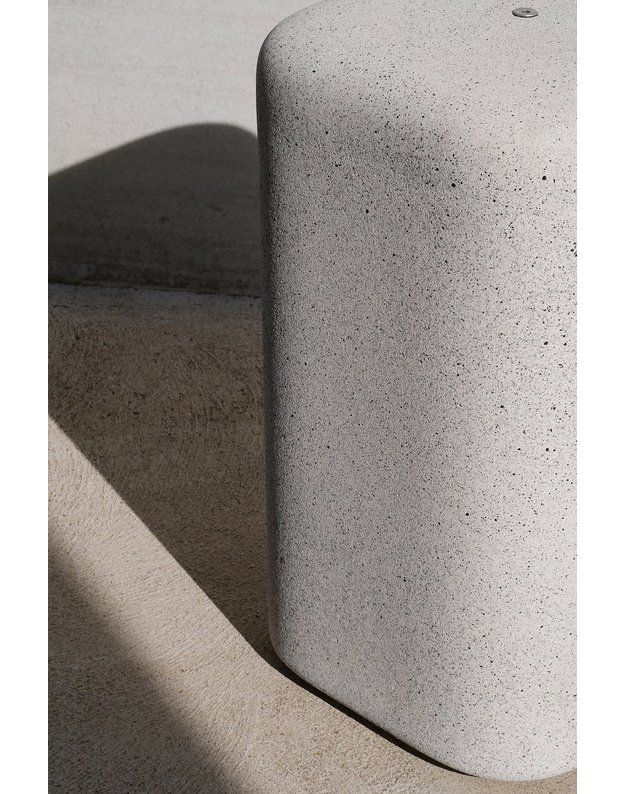
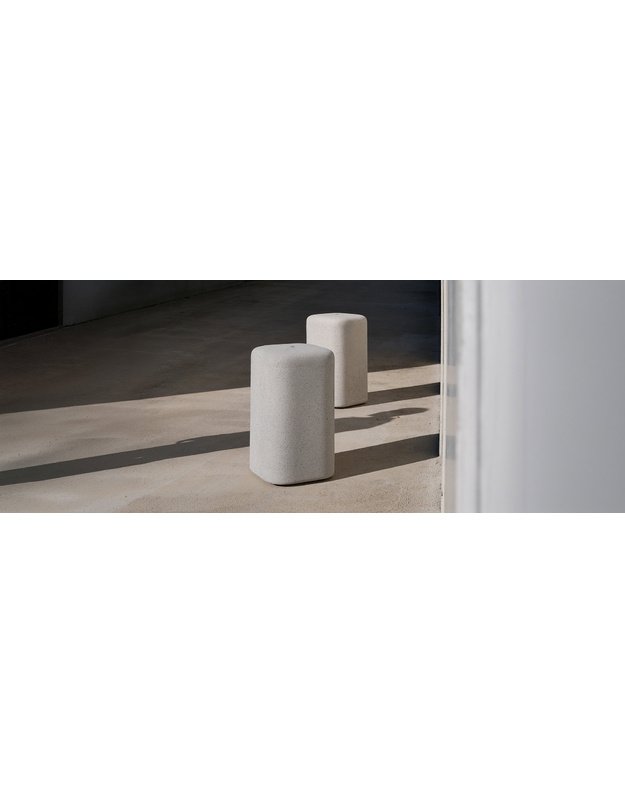
Lancer Bollard is designed for traffic calming in urban spaces: the clean geometry of a square prism with rounded edges combines safety and strength. Its 45 cm square base and 75 cm height meet accessibility and road safety recommendations – the bollard is clearly visible to pedestrians and drivers, with no risk of snagging, making it ideal for separating pedestrian zones and marking clear urban boundaries. It is cast from through-coloured high-performance self-compacting concrete (HPC), with a sandblasted surface that exposes fine 1–12 mm granite aggregate, and finished with a hydrophobic and anti-graffiti coating. A socket on top takes a screw-in lifting eye, so the bollard can be safely lifted and moved with a sling.
| Material | through-coloured cast high-performance concrete (HPC); CEM I 52.5 cement, marble and granite aggregates |
| Surface | sandblasted, exposed aggregate; hydrophobic and anti-graffiti coating |
| Dimensions | 450 × 450 × 750 mm |
| Weight | 335 kg |
| Concrete properties | compressive strength 35–45 MPa, water absorption 8 %, fully frost-resistant |
| Certificates | CE, UNE-EN 12620, ISO 9001:2015 |
| Lifting | M12 socket on top for a screw-in eye bolt, lifted with a polyester sling; after installation the socket is closed with a countersunk M12 bolt |
| Installation | must be fixed to the paving: the base has sleeves for two M20 threaded bolts fixed with nylon anchors |
| Packaging | 4 pcs per pallet, 1200 × 1000 × 750 mm, 1340 kg |
| Maintenance | no maintenance required; dirt and graffiti are removed with hot water using a high-pressure washer |
Pedestrian streets and squares, entrances to courtyards and sites, pavements by schools, public buildings and shopping centres – wherever cars need to be stopped while leaving free passage for pedestrians.
Space the bollards so that a pushchair or wheelchair can pass freely between them, but a car cannot. For a more massive, stone-like barrier, choose the Little Island Bollard.
Concrete bollards are heavy, so they are usually simply placed in position, and the stone chip finish goes well with concrete benches, planters and paving blocks. Metal bollards are slimmer, suit narrower spaces and are fixed to the base. Choose according to the space available and the style of other outdoor furniture.
Usually not – concrete bollards stand stably thanks to their weight and are hard to move by hand. It is enough to place them on a level, firm base. The exact weight of each model is stated in the product's technical data.
Depending on the model, a metal bollard can be extended and set in concrete, bolted to the paving with a flange, or mounted with a flange under the paving. In newly laid paving, the set-in-concrete version is the most reliable. If the surface is already in place and you do not want to break it up, choose a bolt-down bollard.
Low bollards suit the edges of lawns and flower beds – they mark the boundary without dominating the surroundings. Taller bollards are more visible to drivers and do not disappear in a snowdrift. At crossings and junctions, choose a height at which the bollard does not obscure children and traffic signs.
Choose the gaps so that pedestrians, pushchairs and wheelchairs can pass through comfortably, but a car cannot enter. It is worth agreeing the exact distances with the site project or the municipality. If needed, the bollards can be linked with a chain.
Some metal bollards have a cap with a reflective coating that shines in headlights and shows where the boundary is. A coloured cap can also highlight the purpose of the zone. This is especially useful near schools, crossings and car parks.
Yes, chain loops can be ordered for metal bollards on request. This creates a temporary or permanent barrier, for example to block a driveway. Specify whether you need loops when ordering.
Yes, we deliver and install throughout Lithuania – contact us on +370 652 32015, info@viskasmiestui.lt. We will choose the installation method depending on whether the paving is already laid or is still being laid.
